Running a band class for teens
The class teenagers stay in for the friends: grouping a band by level and instrument, a term that ends in a gig, the rehearsal room, and pricing it beside privates.
Apr 14, 2026 · 5 min read
A fifteen-year-old guitar student has taken a half-hour private lesson every week for four years. They're good now. They're also about to quit, because scales alone in a bedroom were never why they picked up a guitar. They wanted to play with other people.
A band class is the answer, and for a lot of music schools it's the class that keeps teenagers through high school. Privates build the skill. The band gives it a reason: four friends who need you to know your part by Tuesday, and a gig at the end of the term.
Here's how to run one that works.
Building a band
A band is four to six players: drums, bass, one or two guitars, keys, and a voice. Grouping them well matters more than anything else you'll do.
Level before age. A strong 13-year-old drummer and a 16-year-old guitarist at the same level play well together. Keep the ages within about three years, so they actually want to hang out, but match them on what they can play.
A floor to join. Something like: about a year of lessons, can play a simple song through at tempo without stopping, and knows the basic chords or grooves for their instrument. Beginners in a band don't learn faster; they stall the others.
A ten-minute placement. Before the term, each student plays a song they know, then plays along with a teacher on something simple, like a four-chord pop progression. You'll hear in two minutes who listens and who just plays louder.
The drummer problem. You will have eight guitarists and one drummer. Plan for it:
- Ask a guitarist to try bass. Most can hold a bass line within a few weeks, and a good bassist is gold.
- Recruit from your drum privates directly, with a lower price for the band if they're already taking lessons.
- Let a teacher sit in on drums or bass for a band missing one, for a term, while you find someone.
- Keep a waitlist for guitarists and fill bands as the rhythm sections appear.
Singers are the other gap. Often a guitarist sings. Sometimes a voice student wants to try it with a band. Ask.
A term that ends in a gig
Without a date to play, a band class drifts into jamming. A gig gives every week a job. A twelve-week term might run like this:
- Weeks 1–2: choose three or four songs. One the band picks, one the teacher picks, one that stretches them.
- Weeks 3–9: learn them, a section at a time. Parts are learned at home; rehearsal is for playing together.
- Weeks 10–11: run the whole set, start to finish, as if it were the night.
- Week 12: the gig.
The gig itself: a Friday or Saturday evening, every band plays its 15-minute set, family and friends come. Your biggest studio works, or a community hall nearby. Keep it all-ages, and set a rule early about lyrics: it's a family audience, and a quiet word in week 1 saves an awkward one in week 11.
Film it for the families (with their permission), and put the date on the calendar on the first day, so nobody books a hockey tournament over it.
The rehearsal room
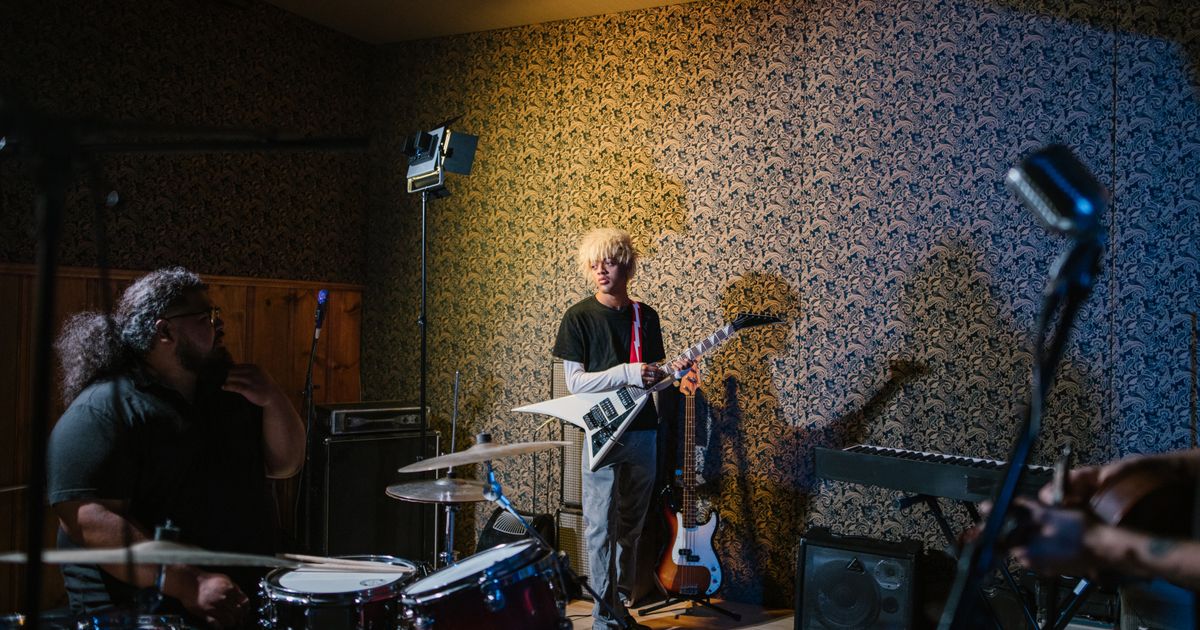
Bands are loud. One room has to take that, with:
- a drum kit that stays set up, a bass amp, two guitar amps, a keyboard and a small PA with two microphones;
- earplugs in a jar by the door, and a volume rule ("if you can't hear the singer, everyone's too loud");
- ten minutes at each end for setup and teardown, built into the class length. A 90-minute session is about 70 minutes of playing.
Schedule it when the rooms next door are quiet. A band at 6:00 PM beside a beginner piano lesson is unfair to both. Saturday afternoons or the last slot of a weeknight usually work.
One rule that saves arguments: students bring their own guitars, the house kit and amps stay, and nobody touches the drums except the drummer.
Pricing it beside privates
Parents will compare the band to a private lesson. So should you.
Say a weekly 30-minute private is $35. Twelve weeks is $420. A band class of five students, 90 minutes a week, at $25 a student a week is $300 for the term. The family pays less than a private. You bring in $125 for 90 minutes of one teacher's time, about $83 an hour, against $70 an hour for back-to-back privates. Both sides come out ahead.
The band shouldn't replace privates, though. The students who grow are the ones doing both: privates for technique, the band for everything else. Make that the easy choice:
| What | 12 weeks |
|---|---|
| Private lessons alone | $420 |
| Band alone | $300 |
| Both together | $660 |
That's $60 off for doing both. Say it in one line on the band's page: "Already taking lessons with us? The band is $240 for the term."
Keeping the band together
The band is why they stay, so treat it like something that belongs to them.
- Let them name it. It goes on the gig's poster and in every email.
- Keep a band together term after term when it works. Move players up as a group, not one at a time.
- Give them a little say, like picking one song a term or the order of the set. Teenagers stay where they're listened to.
- When someone leaves, fill the spot before the next term starts, and let the band meet the new player before the first rehearsal.
Where Caletan fits
In Caletan, each band is its own class with its spots and its ages, and the rehearsal room is held for every session, so a private lesson can't be booked into it. For a band you place yourself, turn off online registration and enroll each player from the desk. The class guide has each step, and for music schools shows how lessons and the gig's tickets fit too.